Let’s look at the seven most common water storage challenges farmers have to face.
One of the biggest issues is a silent thief – evaporation. In our hot, dry climate, traditional open-air earth dams and concrete reservoirs lose a staggering amount of water to the atmosphere every day. This means that much of the water you worked hard to collect is disappearing before you can even use it.
If you are using older dams, you might notice they are becoming shallower over time. This is due to siltation and sedimentation, where dust, silt and organic debris settle at the bottom. This makes your storage less efficient and often leads to the need for labour-intensive dredging to fix the original depth.
Maintaining the physical structure of your storage is another massive headache. Many older concrete dams develop cracks and leaks that are incredibly difficult to seal, while older steel tanks can succumb to corrosion. This is especially true if your water source has higher pollutant levels, which can shorten the lifespan of your metal units and irrigation equipment.
Beyond the structure itself, keeping the water clean is vital. Open storage is susceptible to contamination from dust, vermin, and algae growth. This is a major concern because producing contaminated crops or using dirty water in manufacturing can lead to serious liabilities under the Consumer Protection Act.
Energy reliability also plays a huge role in how you access your water. Many systems rely on electrical pumps, but with the ongoing strain on the national grid, a power outage can leave your stored water completely inaccessible. To combat this, many are moving toward gravity-fed systems and decentralised storage points to ensure the water flows even when the power does not.
Of course, the financial side cannot be ignored. Setting up high-capacity tanks or drilling boreholes is a capital-intensive investment, and the ongoing costs of checking for leaks and monitoring levels can be high. Without proper support, a single failure in a dam wall can be economically catastrophic.
Finally, we must consider our climate. Rainfall in recent years has often been intense but brief, leading to rapid runoff that is hard to capture. Coupled with the expectation of an El Niño summer this year, it is important to have ample reserve storage that can handle these massive, sudden inflows, while creating a buffer for the long dry spell that is forecast.
The road ahead requires a smart blend of modern technology and proactive management. By moving away from aging, open systems and embracing enclosed, protected storage, you are doing more than just saving water; you are building resilience for your farm. Considering flexible and inexpensive solutions such as Damsak® is the most effective way to ensure that whether you are growing crops, managing livestock, or running an industrial site, you have the security you need to thrive in the seasons to come.
]]>South Africa is a naturally water-scarce country, receiving only about 464–497mm of rainfall annually — nearly half the global average. Learn more about SA’s water scarcity (World Resources Institute)
This limited supply is further strained by degradation of wetlands and water resources, siltation of dams, population growth, urbanisation, inefficient use, and changing lifestyles. In fact, nearly all available water resources are already allocated, leaving very little room to meet growing demand. National State of Water Report (Department of Water and Sanitation)
If current trends continue, South Africa could face a 17% gap between water supply and demand by 2030. Water supply gap projections (Digital Mall Blob Storage)
Communities on the Frontline
For many communities — especially in rural areas and informal settlements — water insecurity is a daily reality. While a majority of households have some form of access, reliability remains a major issue, with many still depending on inconsistent supply systems or unsafe sources. SA water access overview (Trade.gov)
The consequences go beyond inconvenience. Limited access to clean water impacts health, education, and local economic activity. It also disproportionately affects women and children, who often carry the burden of sourcing water for households.
The Overlooked Pressure: Farming Communities
Water insecurity doesn’t just affect households — it directly threatens South Africa’s farming communities and food systems.
Agriculture uses approximately 60% or more of the country’s available water, making it the single largest consumer. Agriculture and water use in SA (IOL)
For commercial and small-scale farmers alike, an unreliable water supply can lead to reduced crop yields, financial instability, and rising food prices nationwide. Irrigation systems depend heavily on consistent water access, yet prolonged droughts, erratic rainfall, and infrastructure failures are making this increasingly difficult.
In rural farming regions, groundwater is often the fallback, but over-extraction and poor management are placing additional pressure on already fragile systems. (Daily Maverick)
Simply put, when farming communities don’t have water, the ripple effects are felt on every dinner table in South Africa.
Beyond Policy: The Need for Immediate Action
Water security is not only about long-term policy — it is about immediate, practical solutions.
Large-scale infrastructure projects remain important, but they are often slow to implement. Communities facing urgent shortages cannot wait years for traditional concrete reservoirs or bulk systems to be completed.
What is needed is a dual approach:
- Long-term planning and governance reform, and
- Rapid, scalable infrastructure solutions that can be deployed quickly where they are needed most
This includes modular storage, alternative reservoir systems, and durable, cost-effective technologies that can support both communities and agricultural operations.
A Shared Responsibility
At its core, water security is a human issue — one that underpins dignity, health, food security, and economic participation.
At Damsak, we believe our role extends beyond manufacturing. It is about enabling access — providing fast, reliable infrastructure solutions that help communities and farming regions respond to immediate needs while supporting long-term resilience.
The Human Rights Festival reminds us that rights are not theoretical — they must be realised in lived experience.
Water is not a privilege.
It is a right.
And in South Africa, it is a right that cannot wait.
]]>The global launch allows Damsak® Reservoirs to transcend borders, offering its cutting-edge water storage solutions to regions grappling with infrastructure challenges. Damsak®’s water storage bladders set the standard for reliability and innovation, empowering businesses to thrive despite water scarcity or continuous supply disruptions ensuring business continuity.
“At Damsak®, we recognise the critical role water plays in sustaining industries and communities. Our expansion to international markets emphasises our commitment to providing scalable, high-capacity solutions to address the challenges faced by businesses globally,” stated Gordon Bredenkamp, Co-founder of Damsak® Reservoirs.
Central to this announcement is Damsak®’s ambitious venture to introduce a size surpassing their largest 250,000-litre Damsak®. The new 333,000-litre Damsak came about due to requests for larger capacity to meet the escalating water demands of businesses worldwide. The product has a 10-year guarantee and boasts large scale roll outs for plants in need of food grade and/or general usage.
Damsak® water storage bladders are engineered with a focus on reliability, durability, and ease of installation and transportation. These reservoirs provide a robust solution during infrastructure failures or water supply disruptions, ensuring continuous operations for businesses reliant on water-intensive processes. From sustaining manufacturing operations to supplying food-grade water for employees, Damsak® guarantees an undisrupted workflow, fostering business continuity even in challenging circumstances.
With a vision to develop sustainable water storage management, Damsak® Reservoirs demonstrates a high standard of innovation and resilience, offering a lifeline to businesses facing water-related impediments.
For further questions or enquiries, please get in touch with Celeste Burger.
Contact details
Cell: 0824613748
About Damsak® Reservoirs: Smart Water Storage.
Damsak® Reservoirs is a leading provider of cutting-edge water storage solutions committed to revolutionising water infrastructure globally. With a focus on innovation and reliability, Damsak® Reservoirs empower businesses and communities to overcome water-related challenges, ensuring sustainable access to this precious resource.
]]>The global launch allows Damsak® Reservoirs to transcend borders, offering its cutting-edge water storage solutions to regions grappling with infrastructure challenges. Damsak®’s water storage bladders set the standard for reliability and innovation, empowering businesses to thrive despite water scarcity or continuous supply disruptions ensuring business continuity.
“At Damsak®, we recognise the critical role water plays in sustaining industries and communities. Our expansion to international markets emphasises our commitment to providing scalable, high-capacity solutions to address the challenges faced by businesses globally,” stated Gordon Bredenkamp, Co-founder of Damsak® Reservoirs.
Central to this announcement is Damsak®’s ambitious venture to introduce a size surpassing their largest 250,000-litre Damsak®. The new 333,000-litre Damsak came about due to requests for larger capacity to meet the escalating water demands of businesses worldwide. The product has a 10-year guarantee and boasts large scale roll outs for plants in need of food grade and/or general usage.
Damsak® water storage bladders are engineered with a focus on reliability, durability, and ease of installation and transportation. These reservoirs provide a robust solution during infrastructure failures or water supply disruptions, ensuring continuous operations for businesses reliant on water-intensive processes. From sustaining manufacturing operations to supplying food-grade water for employees, Damsak® guarantees an undisrupted workflow, fostering business continuity even in challenging circumstances.
With a vision to develop sustainable water storage management, Damsak® Reservoirs demonstrates a high standard of innovation and resilience, offering a lifeline to businesses facing water-related impediments.
For further questions or enquiries, please get in touch with Celeste Burger.
Contact details
Cell: 0824613748
About Damsak® Reservoirs: Smart Water Storage.
Damsak® Reservoirs is a leading provider of cutting-edge water storage solutions committed to revolutionising water infrastructure globally. With a focus on innovation and reliability, Damsak® Reservoirs empower businesses and communities to overcome water-related challenges, ensuring sustainable access to this precious resource.
]]>In the face of this crisis, individual and collective action is crucial. Fixing leaks promptly, reducing shower times and household water usage, and investing in efficient appliances are just a few steps residents can take to save water. Moreover, rainwater harvesting and saving of grey water is an eco-friendly way to supplement potable water for non-potable uses like gardening, washing cars, and cleaning. This can significantly contribute to conservation efforts. Raising awareness about water conservation within communities and workplaces is equally important to foster a culture of responsible water usage.
“The water crisis in South Africa demands a collaborative effort from individuals to industries,” said Gordon Bredenkamp, co-founder of Damsak® Reservoirs.
In the pursuit of alleviating the water crisis, effective water storage solutions are imperative. Here, we present a comprehensive comparison of Damsak® storage bladders made from polyester-reinforced potable grade, plasticised polyvinyl-chloride (PVC) with various other storage options, including steel tanks, plastic (polyethene and polypropylene) tanks, fibreglass tanks, concrete tanks, and stone tanks.
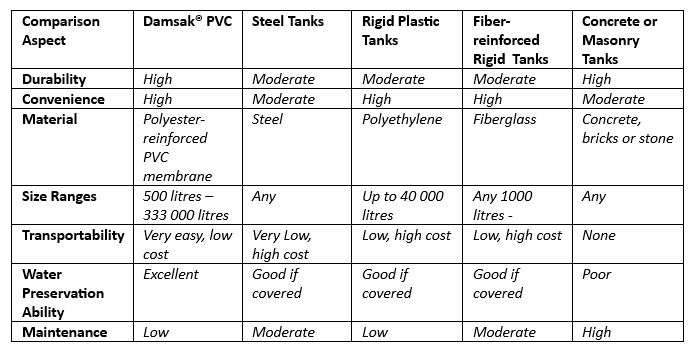
Damsak® Reservoirs, constructed from high-quality Plasticised PVC, stand out as a versatile, durable, and efficient water storage solution. They are quick to install, available in various size options, and highly portable. Damsak® Reservoirs have a proven track record in preserving water quality and are easy to maintain, ensuring long-term cost-effectiveness.The first Damsak was manufactured in 2007.
“Damsak® Reservoirs stand as a testament to innovation and sustainability, offering a lifeline to South Africa’s water security,” said Dawid Bredenkamp, co-founder of Damsak® Reservoirs.
A key advantage of Damsak® is transportability and the fact that it can come in large sizes of up to 250 000l. Many Businesses have taken this proactive approach to ensure they have a reliable water supply on their premises. This enables business continuity and ensures the hygiene and safety of staff and employees.
Additionally, let’s not overlook the importance of governmental initiatives and industry efforts.
According to Eyewitness News, Rand Water’s Makenosi Maroo said, “In line with the Minister’s directive, Rand Water is implementing water shifting as a management tool to balance its systems. Simply put, water shifting means moving or shifting water from one system to another to ensure a balanced and equitable water supply to municipal customers and residents.” This is just a cover up statement to disguise the fact that the system is inadequate to reliably deliver water, which is available, to where it’s needed. Frankly, I believe Damsak should never be implicated in anything that has any political connotation. Preferably, no politician’s name should ever be mentioned!
This approach, coupled with individual conservation efforts and innovative water storage solutions like Damsak® Reservoirs, can collectively contribute to a more water-secure and sustainable future for all South Africans.
To read more about water shifting and water infrastructure constraints, refer to the below news articles:
- Mchunu calls for water shifting to address water outages. – SAnews (October 4, 2023) – https://www.sanews.gov.za/south-africa/mchunu-calls-water-shifting-address-water-outages
- Water-shifting warning for indebted municipalities. – Daily Investor (October 3, 2023) https://dailyinvestor.com/south-africa/34617/water-shifting-warning-for-indebted-municipalities/
- ‘Water shifting’ interim plan to be implemented in Gauteng, says Minister Mchunu. – EWN (October 1, 2023) https://ewn.co.za/2023/10/01/water-shifting-interim-plan-to-be-implemented-in-gauteng-says-minister-mchunu
- EXPLAINED | What is ‘water shifting’ and why is Gauteng introducing it? – TimesLIVE (September 29, 2023) https://new.timeslive.co.za/articles/news/south-africa/2023-10-01-rand-water-to-implement-water-shifting-in-gauteng
- Gauteng gets green light to implement ‘water shifting’. – SowetanLIVE (September 28, 2023) https://www.sowetanlive.co.za/news/south-africa/2023-09-28-gauteng-gets-green-light-to-implement-water-shifting /
The Water Crisis in South Africa
The water crisis in South Africa has been driven by a combination of factors, including prolonged droughts, changing weather patterns, electricity shortages affecting the continuous flow of water, and increasing demand due to population growth and economic activities. These factors have put immense pressure on existing water resources, leaving farmers struggling to secure an adequate and reliable water supply for their crops and livestock.
Impact on the Farming Industry
The farming industry has endured the brunt of the water crisis, facing challenges that threaten livelihoods and food security. Insufficient water supply leads to reduced crop yields, reduced quality of produce, and increased stress on livestock, leading to rising production costs and decreased profitability for farmers. Additionally, water restrictions and uncertainties have made long-term planning and investment in agriculture a risky proposition.
Damsak Reservoirs: A Solution for Sustainable Agriculture
Amidst the water crisis, Damsak Reservoirs can offer hope to farmers and agricultural businesses in South Africa. Their innovative water storage solutions provide a range of features that set them apart from competitors, making them the ideal choice for the agriculture industry.
- Durable and UV-Protected: Damsak Reservoirs are built to withstand harsh weather conditions, ensuring long-lasting durability even in the sunniest and most challenging environments. Their UV protection prevents degradation, keeping it safe and clean for multi-purpose uses.
- Reliability: Damsak Reservoirs are engineered to deliver a consistent and reliable water supply. By storing water during periods of plenty, farmers can ensure a steady supply during droughts, mitigating the impact of water shortages on their crops and livestock.
- Scalability: Whether it’s a small family-owned farm or a large-scale agricultural enterprise, Damsak Reservoirs offer scalable solutions to suit diverse needs. Farmers can choose from various sizes to match their specific water storage requirements.
- Easy Installation and Maintenance: Damsak Reservoirs boast user-friendly installation and low maintenance, minimising downtime, and operational disruptions for farmers.
- Environmentally Friendly: By promoting water conservation and sustainable water usage, Damsak Reservoirs contribute to preserving South Africa’s delicate ecosystems and reducing the industry’s overall water footprint.
Embracing a Sustainable Future
In the face of the ongoing water crisis, investing in a Damsak water storage bladder is not just a practical decision for the farming industry; it’s a commitment to a sustainable future. By securing a reliable water supply, farmers can strengthen their resilience against the uncertainties of climate change and protect their livelihoods for generations to come.
By adopting Damsak’s water storage solutions, stakeholders in the farming industry can take a significant step towards sustainability, ensuring the growth and prosperity of agriculture in South Africa despite the challenges posed by water scarcity.
Damsak® Reservoirs is a registered South African product, first designed and manufactured in 2007. We commit to a 10-year guarantee on workmanship, if used in the recommended conditions. Our water storage solution is compact and easy-to-transport, providing an adequate and reliable solution for water storage in the farming, agricultural, manufacturing, and commercial industries.
Contact us on 063 565 6463 to get your own Damsak. Or send an email to sales@damsak.co.zw if you have any questions.
]]>